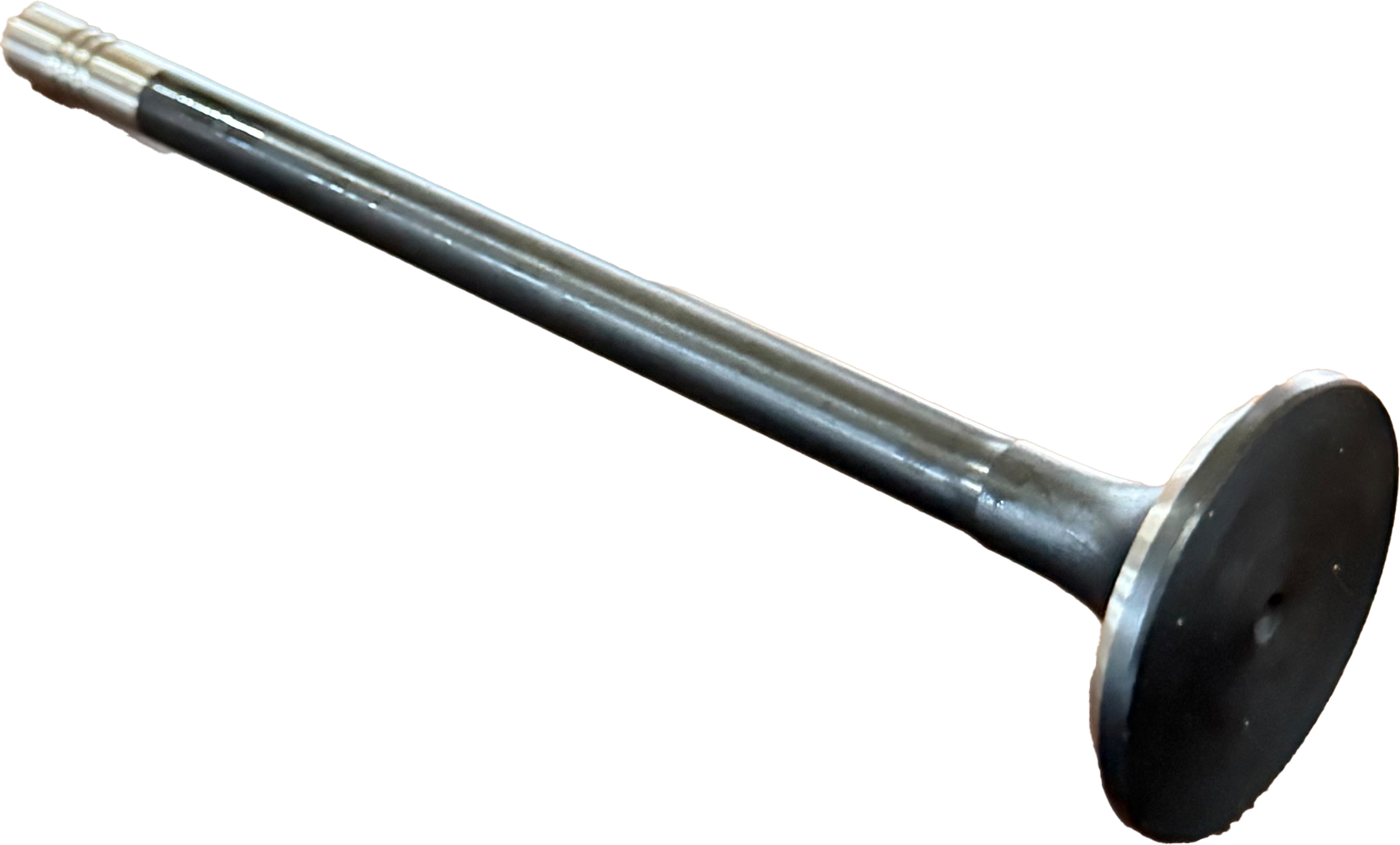
The exhaust valve is an important component in the engine valve train, and its function and working principle are as follows:
1. Basic functions
Exhaust gas discharge: Open during the exhaust stroke to discharge the burned exhaust gas from the cylinder to the exhaust manifold, and finally release it into the atmosphere through the exhaust system.
Sealed combustion chamber: Ensure the sealing of the combustion chamber when closed (tightly fitting with the valve seat), maintaining the pressure of compression and power stroke.
2. Structure and Materials
Head: usually made of high-temperature resistant alloy steel (such as nickel chromium alloy), due to direct contact with high-temperature exhaust gas (up to 600-900 ℃).
Rod: Surface hardening treatment to reduce friction with valve guides.
Valve cone angle: commonly 45 ° or 30 °, to ensure sealing with the valve seat.
Hollow sodium filled design (for some high-performance engines): Sodium melts at high temperatures and helps dissipate heat through flow.
3. Work cycle
Opening timing: Start in advance at the end of the exhaust stroke (before the piston approaches bottom dead center) (using exhaust gas pressure to naturally discharge).
Closing timing: Delay closing at the beginning of the intake stroke (after the piston passes the top dead center), and use the inertia of the airflow to further exhaust the exhaust gas ("valve overlap angle").
4. Common faults and their impacts
Carbon deposition: leading to loose closure, decreased compression ratio, and insufficient power.
Erosion: High temperature exhaust gas corrodes the edge of the valve, causing air leakage.
Wear and tear: The gap between the rod and the guide tube increases, resulting in abnormal oil consumption (blue smoke).
Fracture: It may be caused by material fatigue or overheating, resulting in serious accidents where the piston collides with the valve.
5. Maintenance points
Regular inspection: Remove carbon deposits and grind the valve sealing surface.
Gap adjustment: For mechanical lifters, the valve clearance needs to be adjusted (hydraulic lifters automatically adjust).
Replacement timing: Usually replaced together with valve guides and oil seals (during major repairs).
6. Difference from intake valve
Higher temperature: The exhaust valve is subjected to a much higher exhaust gas temperature than the intake valve.
Stronger material: requires higher heat resistance, usually more susceptible to damage than intake valves.
Short opening time: The exhaust stroke only accounts for 180 ° of the crankshaft, but efficiency is optimized by early/delayed opening and closing.